


Millions Hungry and Displaced in Sudan: LIFE's Response
Updated: Feb 20
.
What Is Happening in Sudan Right Now?
What is happening in Sudan remains largely unpublicized. Despite the scale of suffering, the war in Sudan has struggled to hold sustained global attention compared with other conflicts. Even as mass displacement and widespread loss of life continue, the crisis has not received the level of coverage or urgency it demands.
That silence is part of the crisis itself. And it is why it is critical to talk openly about what is happening and about the work organizations like Life for Relief and Development (LIFE) are doing to help families survive inside Sudan.
Why Is There War and Violence in Sudan?
Sudan’s current violence stems from a power struggle between rival military factions following a failed transition to civilian rule after decades of political instability and military dominance. As these groups fight for control, government institutions have collapsed.
The consequences have been devastating for civilians. Markets have broken down, health systems have deteriorated, schools have closed, and entire communities have been forced to flee.
Since the conflict began, more than 14 million people have been displaced. Over 9 million remain displaced within Sudan itself, while more than 4 million have crossed into neighboring countries, creating one of the largest displacement crises in the world today.
For many families, especially those fleeing regions such as Darfur, displacement is not a single moment but a prolonged state of survival. They arrive in safer towns with little more than exhaustion, trauma, and uncertainty about what comes next.
How Many People Have Lost their Lives or Been Affected in Sudan?
Estimating casualties in Sudan is difficult due to limited access and reporting restrictions, but available data paints a grim picture. Experts estimate that up to 150,000 people may have died as a result of violence, hunger, and the collapse of health services since the war began.
The humanitarian impact extends far beyond direct violence. Nearly 25 million people are facing acute food insecurity, and famine conditions have already been identified in several areas. More than 30 million people (roughly two-thirds of Sudan’s population) now require humanitarian assistance.
In late 2025, the United Nations warned that severe funding cuts were forcing aid agencies into “survival mode” operations, raising fears that millions could face starvation in 2026 without urgent support.

What Happens to Families After They Are Displaced?
Displacement does not end when families reach safer towns. It marks the beginning of daily emergencies: finding food, accessing clean water, securing shelter, and coping with the psychological toll of loss.
Families often rely on already overstretched host communities, sharing limited resources. Children are among the hardest hit. Millions are out of school due to destroyed or unsafe classrooms, increasing the risk of a lost generation shaped by hunger, trauma, and instability.
Healthcare access has also been severely compromised. Hundreds of health facilities have been damaged or destroyed, leaving treatable illnesses and injuries increasingly deadly.
Humanitarian Aid in Sudan: LIFE’s Emergency Response
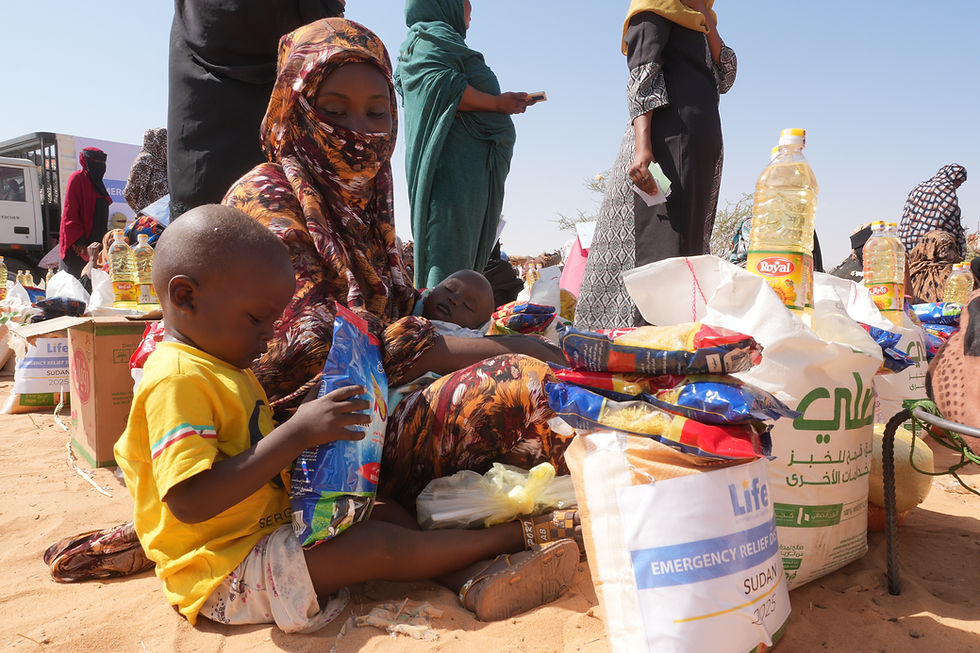
In early December, Life for Relief and Development carried out an emergency food distribution in Al-Ubayyid, a city that has become a refuge for families displaced from Al-Fasher and surrounding areas.
The response focused on families experiencing acute food insecurity, many of them internally displaced and living without a reliable income. Over the course of the operation, hundreds of emergency food packs were distributed directly to families.
Each food pack was designed to meet immediate survival needs, helping households cope with disrupted markets, rising food prices, and lost livelihoods. For families who had already endured months of instability, the assistance provided a measure of relief and dignity.
In Al-Ubayyid alone, the distribution reached an estimated 2,500 people, including 1,000 children and 1,500 adults. Beyond those directly assisted, the intervention helped stabilize surrounding communities. By reducing pressure on shared resources, the support indirectly benefited an estimated 1,250 additional people.

Stories From Sudan
“We left our home with nothing,” shared one displaced mother in Al-Ubayyid. “My children were hungry every day, and I didn’t know how I would feed them. When the food arrived, it felt like someone finally saw us.”
A local volunteer working alongside LIFE’s team described the broader impact: “People here are exhausted, not just physically but emotionally. When aid arrives, it is an enormous source of relief and a reminder that the world is watching and wants to help. That matters more than people realize.”
Sudan’s Crisis Cannot Be Ignored
Sudan’s emergency is not a future risk; it is a present reality affecting tens of millions of people. Families continue to endure hunger, displacement, and uncertainty every day.
Humanitarian aid does not end the conflict, but it saves lives, preserves dignity, and buys time for families caught in circumstances beyond their control.
LIFE’s work in Sudan is part of a broader effort to respond wherever suffering is greatest, and visibility is lowest. In crises like this, action matters especially when silence prevails.


