


The Global Environmental Crisis: Water, Climate, and LIFE’s Impact

Explore how water scarcity and extreme weather are contributing to the latest environmental crisis and LIFE’s ongoing response.
Earth Day is often marked by simple actions. In parks, schools, and neighborhoods, children and adults come together to pick up trash, plant trees, and take part in small acts of care for the environment. These moments are visible and important.
They teach responsibility early and show that caring for the environment can be practiced in everyday life. They also raise a larger question. What does it mean to care for the earth at a time when environmental challenges are no longer occasional or distant, but ongoing and connected to how people live?
In many cultures and traditions, this responsibility is often understood as a shared duty to protect and preserve the natural world for future generations. Today, that responsibility carries new weight.
Environmental awareness is growing, especially among younger generations. At the same time, the scale of the challenges is expanding. Water scarcity, extreme weather, and resource strain are shaping access to food, clean water, shelter, and stability in communities worldwide.
These topics are on everyone’s mind, as they are prevalent in mainstream culture and media. Movies like Project Hail Mary, one of the most talked about science fiction adaptations, center on a global environmental threat and the urgency to respond. At the same time, topics like microplastics and water scarcity are gaining attention across the news and social media.
The environmental challenges we’re facing today are shaping how people live, survive, and rebuild every day. Just as important is how we choose to respond, both as organizations and individuals.

The Global Water Crisis
Conversations around the global water crisis are gaining momentum, and for good reason. This is caused by multiple pressures happening at once: climate stress, tech expansion, population growth, agriculture, and resource mismanagement.
Drought is becoming more severe and harder to recover from. In April 2026, more than 61% of the United States was experiencing drought conditions. In Sub-Saharan Africa, water scarcity continues to affect livelihoods and contributes to widespread food insecurity.
Climate stress is changing rainfall patterns, drying rivers, and making farming less predictable. When water disappears, crops fail, livestock suffer, and food prices rise.
Agriculture plays a major role, accounting for about 70% of global freshwater use. This ties water directly to global food systems. At the same time, new demands are emerging. Artificial intelligence depends on data centers that require large amounts of water for cooling, often drawing from the same freshwater sources that communities rely on.
Population growth adds further pressure. As cities expand, demand increases while infrastructure struggles to keep pace. In many areas, water is overused, polluted, or depleted faster than it can be replenished.
The impact is not equal. For some, water scarcity means inconvenience. For others, it means walking long distances, relying on unsafe sources, or storing water in conditions that pose health risks.
In response, efforts to expand access to clean and reliable water are becoming increasingly critical. LIFE continues to address water scarcity through both immediate and long-term solutions. Across 2023, 2024, and 2025, LIFE constructed close to 400 water wells in 18 countries, including Afghanistan, Ethiopia, Pakistan, Somalia, and Tanzania. These projects are designed to provide consistent access to safe water in communities where shortages are part of daily life.
To expand this work further, LIFE has also invested in a water well drilling rig capable of reaching deeper and more difficult terrain. This allows for faster, more efficient well construction in regions where traditional methods are limited, helping reach communities that were previously inaccessible.
For over two years, Families in Gaza have received clean water every day. 7,200 water containers were delivered, nearly 14 million liters of clean water were supplied, and well generators restored access for 6,000 people, while repairs to damaged wells helped another 200,000 residents maintain a steady water source.
These efforts go beyond providing water. They support health, reduce the burden on families, and create conditions where communities can begin to stabilize and grow. The water crisis continues, so too does Life for Relief and Development’s work to combat shortages and provide sustainable and attainable solutions.


Extreme Weather Patterns are Emerging
Extreme weather is no longer rare. It is becoming a pattern. Floods, storms, droughts, and heatwaves are occurring more often and with greater intensity. Rising temperatures are driving these changes, increasing moisture in the air while also accelerating evaporation. The result is more unpredictable and more extreme conditions.
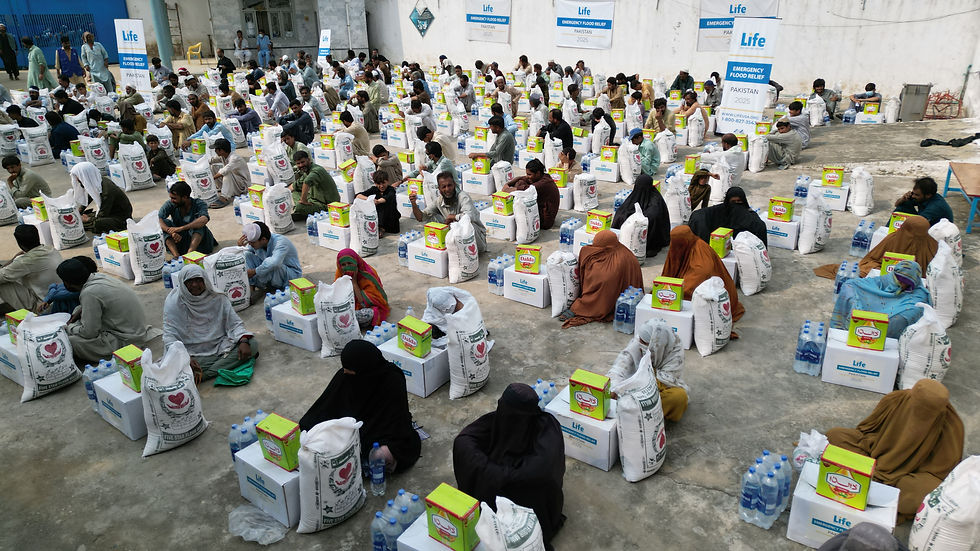
In 2025, disaster struck in parts of Pakistan. Rivers burst their banks, landslides tore through mountainous regions, and severe flooding swept across villages like Bishnoi.
Torrential rain continued as homes near rivers and streams were destroyed, forcing families to flee with only what they could carry. Entire regions of Khyber Pakhtunkhwa, including Buner, Swat, and Bajaur, were affected. While more than 25,000 people were rescued, at least 776 lives were lost, thousands were injured, and many remain missing. Infrastructure was left in ruins, with damages already exceeding $20 million, not including the long-term loss of homes, agriculture, and livelihoods.
In August 2025, a magnitude 6.0 earthquake struck Kunar Province in Afghanistan, followed by aftershocks that reduced entire villages to rubble. More than 2,200 lives were lost, and 3,600 people were injured. With nearly all mud-brick homes destroyed, thousands were left without shelter in remote areas that were difficult to reach.
Hurricanes and storms have also intensified. In 2024, Hurricane Helene made landfall in Florida’s Big Bend as a Category 4 storm, causing catastrophic flooding across the southern Appalachians, widespread wind damage across the eastern United States, and storm surge along the coast. With over 150 direct fatalities, it became the deadliest hurricane to strike the country since Hurricane Katrina.
These events are not isolated; they are part of a broader pattern. And when they occur, they quickly become humanitarian crises. Homes are lost, infrastructure is damaged, and access to food, healthcare, and shelter is disrupted. Families are forced to rebuild under increasingly difficult conditions.
This growing gap between the scale of these crises and the speed of response has been widely recognized. As David Suzuki has said, “We are in a giant car heading toward a brick wall, and everyone is arguing over where they are going to sit.”
Humanitarian organizations are being called to act more frequently and across more complex situations. LIFE has responded to disasters across multiple regions.
Following the 2025 floods in Pakistan, LIFE provided emergency food, clean water, and essential supplies to families forced from their homes, helping stabilize communities in the immediate aftermath.
After the 2025 earthquake in Afghanistan, LIFE deployed mobile medical support, treated hundreds of injured survivors, and distributed food, hygiene kits, and essential supplies to over 150 families in hard-to-reach areas. Teams traveled long distances, often on foot, to reach isolated communities cut off from aid.
In Indonesia, in 2025, where seasonal flooding regularly displaces families, LIFE delivered emergency kits to flood-affected households in West Sumatra, providing essential items such as bedding, blankets, and food to help families recover from sudden displacement.
In Gaza and the West Bank, ongoing support includes shelter, water access, and emergency aid for families facing both environmental and conflict-related challenges. Across Africa, drought response efforts combine immediate relief and long-term recovery.
As extreme weather increases, the need for a coordinated humanitarian response is imperative. Environmental challenges are now directly shaping humanitarian work more than they have in previous years.




What Can You Do?
Environmental challenges can feel overwhelming. Not everyone can influence large systems or control exposure to these conditions. For many, these challenges are part of daily life. At the same time, a response happens at multiple levels.
Individual action matters. Awareness shapes behavior, and small changes can contribute to larger shifts over time.
This can include:
Being more mindful of consumption
Staying informed
Supporting organizations providing direct aid
Advocating for long-term solutions


Looking Ahead
A shift is already taking place. Younger generations are growing up with a stronger understanding of environmental responsibility. At the same time, the challenges ahead are becoming more complex.
Looking forward, LIFE continues to expand its work in both humanitarian relief and sustainable development. This includes increasing access to clean water, strengthening emergency response, and investing in long-term infrastructure.
There is a growing focus on solutions that address both environmental and human needs. Not only responding to crises but also reducing vulnerability before they occur.
We are all stewards of the planet Earth that we call home, and everything that we choose to do or not do affects one another. Intrinsically linked, from the smallest bacteria to the largest mammal known to mankind. So, we must take care of each other and our earth.
The environmental challenges facing the world today are directly tied to our future. The actions we take now will shape how we are all able to live, adapt, and rebuild in the years ahead.
Consider donating to LIFE’s projects that help provide sustainable water solutions and relief to communities facing environmental crises.


